



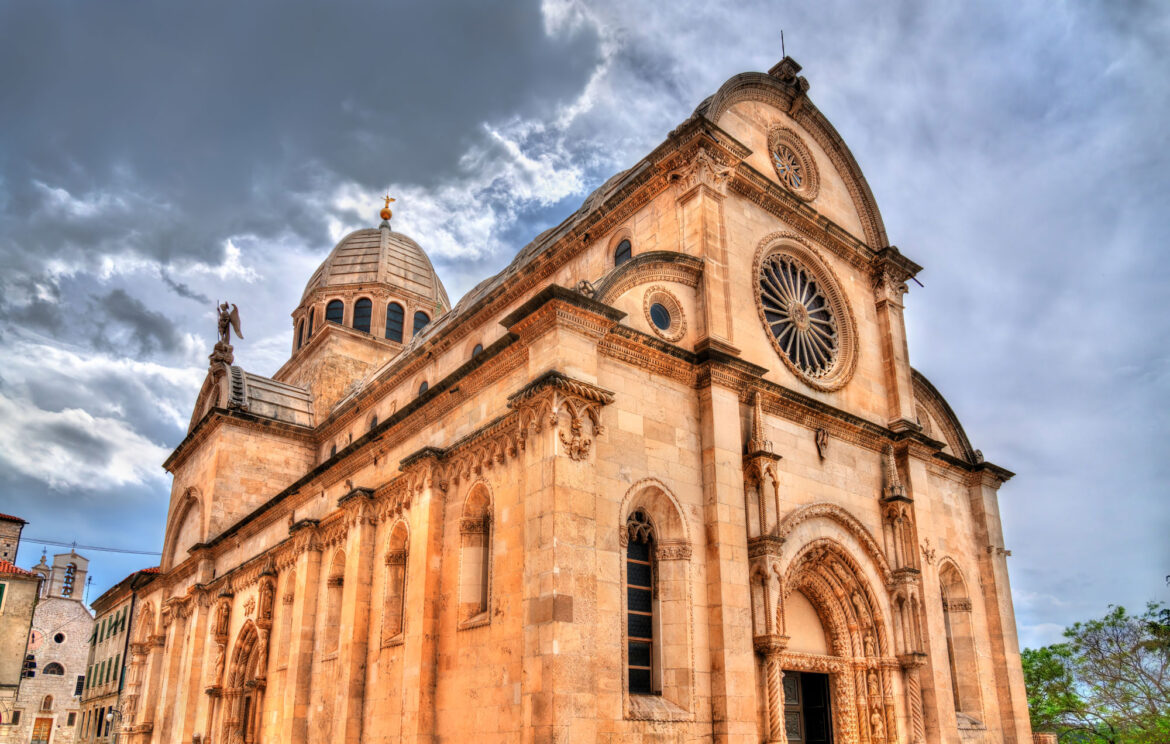
The crowning architectural glory of the Dalmatian coast and the undisputed masterpiece of its principal architect, Juraj Dalmatinac, this UNESCO World Heritage Site is undoubtedly worth a visit. Built entirely from stone quarried on the islands of Brač, Korčula, Rab, and Krk, it is considered the largest church in the world constructed solely of stone without the use of bricks or wooden supports. Another remarkable feature is that its interior shape corresponds exactly to its exterior appearance.
Juraj Dalmatinac was neither the first nor the last architect to work on the cathedral. Construction began in 1431, but after ten years of collaboration with various Venetian builders, the city appointed the Zadar-born architect Juraj Dalmatinac to lead the project. He expanded the structure and transformed its concept into a transitional Gothic-Renaissance style. After his death, the unusual domed complex was completed by Nikola Firentinac, who continued the façade in a pure Renaissance style. The cathedral was finally completed in 1536.
One of the cathedral’s most fascinating features is the frieze of 71 stone heads located on the exterior walls at the rear of the building. These portraits – calm, angry, humorous, proud, and fearful – resemble caricatures, yet they actually depict ordinary citizens of the 15th century. According to legend, the construction was extremely expensive, and the less willing a person was to contribute financially, the less flattering their stone portrait became.
Another highlight is the Lion’s Portal on the northern side of the cathedral, created by Juraj Dalmatinac and Bonino da Milano. Two lions support columns featuring the figures of Adam and Eve, who appear remarkably embarrassed by their nakedness.
Upon entering the cathedral, visitors can pick up an informative brochure available in several languages. It provides a self-guided tour of the most important artworks and architectural details found inside. One of the highlights is Juraj Dalmatinac’s extraordinary baptistery in the rear corner of the cathedral, featuring an exquisitely carved ceiling and a baptismal font supported by three angels.
Other notable artworks inside include the tomb of Bishop Šižigorić by Juraj Dalmatinac, who supported the construction of the cathedral, the altar painting of St Fabian and St Sebastian by Filippo Zaniberti, and a particularly striking 15th-century Gothic crucifix created by Juraj Petrović.