


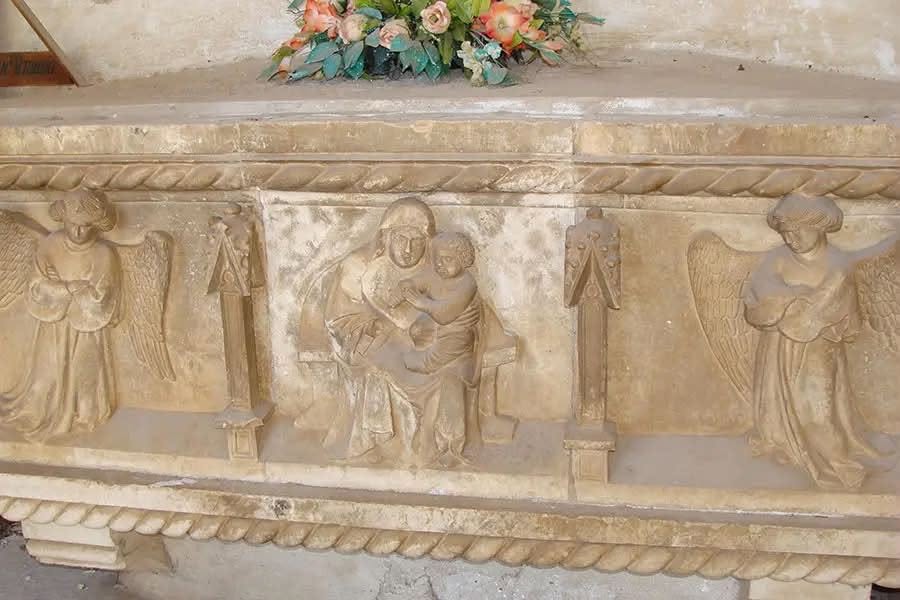
Pirovac has much more to offer than beautiful beaches and an authentic Dalmatian atmosphere. At St George’s Cemetery, inside the Draganić-Vrančić family chapel, lies an exceptionally valuable Gothic sarcophagus dating from the 15th century. Its story is connected to Juraj Dalmatinac, one of the most important architects and sculptors in Croatian history.
A valuable 15th-century sarcophagus
The Draganić-Vrančić family chapel at St George’s Cemetery in Pirovac preserves a remarkable Gothic sarcophagus dating from the 15th century.
Its story begins on 5 January 1447, when members of the Draganić family signed an agreement with stonemason Andrija Budičić and builder and sculptor Lorenzo Pincino.
At the time, both craftsmen were working on the famous Cathedral of St James in Šibenik, today one of the most important architectural landmarks in Dalmatia.
This connection alone makes the sarcophagus an important part of Pirovac’s cultural heritage.
The connection to Juraj Dalmatinac
What makes the story even more remarkable is its connection to Juraj Dalmatinac, one of the most celebrated architects and sculptors in Croatian history.
The sarcophagus was created according to his design and instructions.
Juraj Dalmatinac is particularly famous for his work on the Cathedral of St James in Šibenik. His work during the 15th century had an important influence on architecture and sculpture along the eastern Adriatic coast.
The fact that a work created according to his design is now preserved in Pirovac gives this small coastal town an extraordinary connection to an important chapter of Dalmatian art and architecture.
What can you see on the sarcophagus?
The sarcophagus is also notable for its artistic decoration.
It features a relief of the Virgin and Child between two angels, reflecting the religious art and craftsmanship of the period.
More than five centuries later, the stone relief remains an impressive reminder of the artistic traditions that flourished in Dalmatia during the 15th century.
From Šibenik to Pirovac
The sarcophagus was not originally created for Pirovac.
It was intended for a Franciscan church in Šibenik, where its story began in the 15th century.
In the early 19th century, it was transferred to the Draganić-Vrančić family chapel at the cemetery in Zlosela, the historical name of present-day Pirovac.
It has remained there ever since.
Its journey from Šibenik to Pirovac connects the history of the two towns and has given Pirovac a remarkable piece of 15th-century Dalmatian heritage.
Discover the historical side of Pirovac
Today, Pirovac is best known as a peaceful seaside destination with beaches, restaurants and the relaxed atmosphere of the Adriatic coast. But behind its holiday character lies a surprisingly rich history.
The Gothic sarcophagus in the Draganić-Vrančić chapel is recognised in Pirovac’s official tourism materials as a particularly valuable part of the town’s cultural and historical heritage.
Together with other historical sites in Pirovac, it reveals a side of the town that visitors can easily overlook.
More than 570 years of history
If you are spending your holiday in Pirovac, take some time to discover more than its coastline and beaches.
The Gothic sarcophagus connected to Juraj Dalmatinac has survived for more than 570 years, preserving a remarkable connection between Pirovac, Šibenik and the great masters of 15th-century Dalmatian art.
It is another little-known story that makes Pirovac much more than just a summer destination – and another reason to explore the history hidden behind the streets and stone walls of this charming Adriatic town.